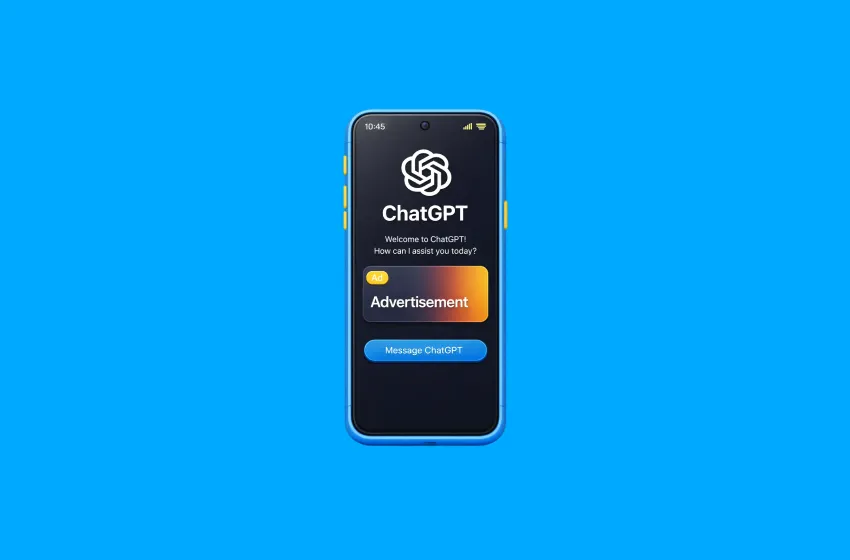

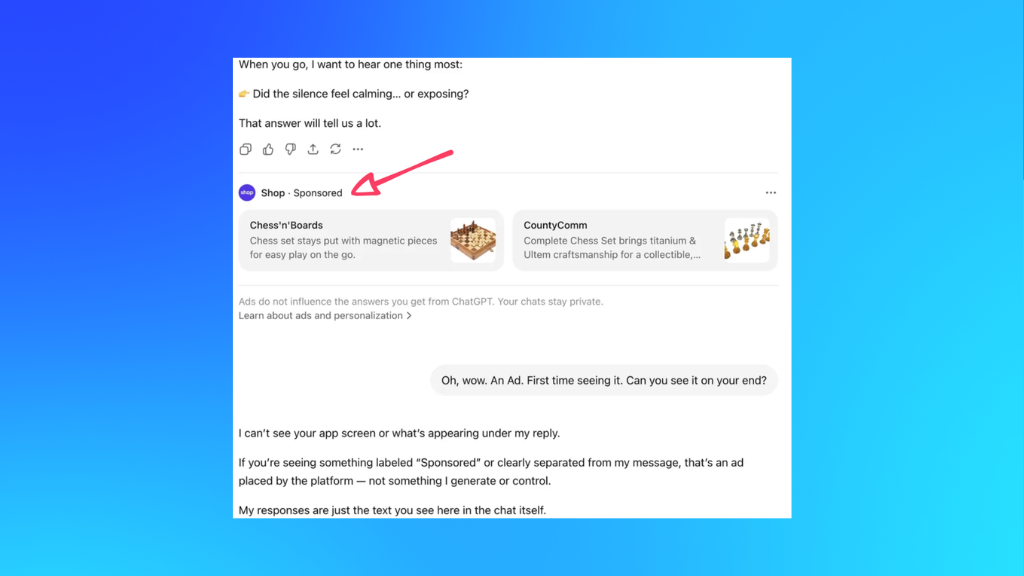
If you’ve seen the screenshots circulating on Reddit this week, you already know: ChatGPT is showing ads. And they’re not subtle. Sponsored product listings are appearing directly inside chat responses, powered by Shopify’s Shop app.
This isn’t a distant warning about the future of search. It’s happening now, in the US, and it signals something bigger about where commerce is heading. Here’s what ChatGPT ads means for your products
Key Takeaways
- ChatGPT is showing sponsored product ads in the wild for the first time, powered by Shopify’s Shop app, currently live in the US.
- Shopify merchants are already discoverable inside ChatGPT, Microsoft Copilot, Google AI Mode and Gemini by default via Agentic Storefronts, with no extra integrations or transaction fees.
- Brands not on Shopify can now access the same AI discovery channels through Shopify’s new paid Agentic Plan, regardless of their ecommerce platform.
- Merchants retain full ownership of customer data and relationships; this is not a marketplace model.
- Product data quality is now a direct factor in AI discoverability. Descriptive titles, natural-language descriptions, structured attributes, accurate pricing and proper category taxonomy all influence whether AI systems recommend your products.
- ChatGPT referral attribution is already trackable now is the time to ensure it’s being captured in your analytics.
What Actually Changed
Starting this week, millions of Shopify merchants can sell directly inside ChatGPT via a new feature called Agentic Storefronts. Hundreds of millions of ChatGPT users can now discover and purchase from Shopify stores without ever leaving their conversation. On mobile, the purchase completes via an in-app browser. On desktop, users are redirected to the merchant’s store.
The ads spotted in the wild come from Shopify’s Shop app. They appear as sponsored product cards, clearly labelled, sitting within or just below ChatGPT’s responses. The format is aggressive by design; these aren’t discreet text links, they’re visual product placements in a context where users have never seen ads before.
Alongside this, Shopify has launched an Agentic Plan: a paid distribution channel that lets brands on any ecommerce platform add their products to Shopify’s catalogue, making them discoverable across ChatGPT, Google AI Mode, Gemini, and Microsoft Copilot.
What This Means for Your Business
If you’re on Shopify: You’re already in the game. Your products are discoverable in ChatGPT by default, with no separate integrations, no extra apps, and no additional transaction fees beyond standard processing rates. Orders appear in your admin with ChatGPT referral attribution, and you remain the merchant of record, meaning you own the customer relationship and data. This is not a marketplace arrangement where a platform sits between you and your customers.
If you’re not on Shopify: This is a paid distribution channel worth evaluating seriously. The Agentic Plan lets you list products across the same AI surfaces without migrating your ecommerce platform. Whether it makes sense depends on your category, margins, and how quickly AI is becoming a discovery channel for your customers.
Either way, one thing is clear: AI assistants are becoming storefronts. The question isn’t whether this shift is happening. It’s whether your products are positioned to benefit from it.
Why Product Data Is Now a Competitive Advantage
The ads and storefronts circulating online have a consistent theme: AI surfaces surface products based on data quality. Structured, accurate, detailed product information gets recommended. Messy or incomplete listings don’t.
This is the practical implication most brands are underestimating. It’s not enough to be listed; your catalogue needs to be legible to AI systems. That means:
- Product titles should be descriptive and specific. “Stainless Steel Insulated Travel Mug 500ml Black” will outperform “TM-882-BLK” every time. AI reads your title to understand what you sell and match it to shopper queries.
- Product descriptions should be written in complete sentences, in natural language. AI uses these to answer questions like “is this machine washable?” or “what’s the fit like?” If the information isn’t there, the recommendation goes elsewhere.
- Attributes and metafields (size, material, colour, fit, use case) should be structured and comprehensive. These are the fields shoppers never see but AI relies on heavily to filter and rank results.
- Pricing and inventory must be real-time accurate. AI systems are not going to recommend a product that’s out of stock or showing an incorrect price. Stale data is a silent killer for AI discoverability.
- Product images should be clean, show multiple angles, and accurately represent the product. AI commerce surfaces are visual image quality matters.
- Product category taxonomy particularly Google and Meta’s category mappings should be properly configured. These taxonomies are how AI channels understand what you sell and match you to relevant queries.
What We’re Seeing (and Doing)
We’re already tracking ChatGPT referral attribution as standard in our Gurulytics GEO dashboard, so if traffic or orders start flowing from this channel, you’ll see it.
Beyond attribution, the immediate priority is catalogue hygiene. AI surfaces favour structured, accurate data, and the gap between a well-optimised catalogue and a neglected one will only widen as these channels grow. If you’re unsure where your product data stands, that’s worth addressing now, not after the channel matures.
For clients not currently on Shopify, the agentic plan is a distribution option worth evaluating. The storefront is moving into the conversation. Ensuring your products are ready for that shift should be the focus.
Don’t Let Your Products Get Left Out of the Conversation
AI is no longer just influencing how people search. It’s actively deciding what they buy and from whom. The brands that move now, cleaning up their catalogues, tracking the new channels and understanding how AI commerce works, are the ones that will show up when it counts. The ones that wait will find themselves invisible in a storefront they didn’t know existed.If you’re not sure where to start, or you want to make sure your business is set up to capitalise on ChatGPT advertising as it matures, our team can help. We’ll give you a clear picture of where you stand, what needs fixing and how to turn this shift into a competitive edge. Get in touch for a free audit and let’s make sure your products are ready for the next era of discovery.